New Zealand has an estimated 20,000 different fungi species, of which only about 4,000 have been described. Of these, only 600 or so are shown on this website, so don't be surprised if you can not identify the one you have.
It helps if you have made a spore print to determine the spore colour to use this quick guide, as the spore colour helps to reduce the number of possibilities!
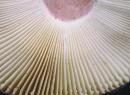
Growing from the ground or rotting wood, and sometimes from living trees with or without stalks. This is where many fungi are found and where spore prints help to reduce the possibilities.
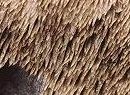
These are fungi that have spines rather than the usual gills. Sometimes a magnifying glass is needed to see them. These can be found growing from the ground or rotting wood
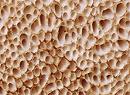
These are fungi which have pores rather than the more common gills, most of which are Mycorrhizal. Therefore, are found under leptospermum and Nothofagus trees or introduced exotics.
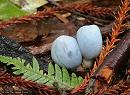
With or without a short stalk, with no obvious way to release their spores. Relying instead on being eaten by insects, which then spread the spores in their faeces. Some are brightly coloured, others not so
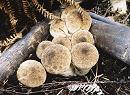
These fungi release their spores ether through a pore at the top or disintegration of the outer wall. Exposing the sponge like interior.
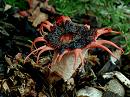
Immature plants look like eggs as they mature. The smell soon indicates where this group gets its name from. Many of which mimic flowers with bright colours.
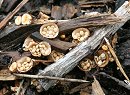
Another group that is identified by their appearance, that are cup-shaped and appear to contain eggs.
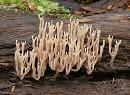
A very difficult group to identify without a microscope and a lot of experience. They are found in a wide variety of colours and shapes, from a simple club to a very branched structure. Growing singly or in small groups or clumps from the ground or less common wood.
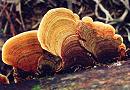
A thin bracket like or typical mushroom shape growing from wood. Spores are released from pores, which, in most cases, are too small to see.
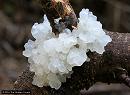
Soft jelly like fungi which come in a wide range of colours, from transparent to yellow, orange and red.
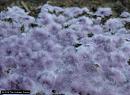
Another group of fungi that are difficult to identify. It's easy to mistake immature bracket and polypore fungi as belonging to this group.
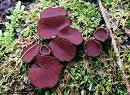
These come in a wide range of colours, some of which have short stalks. size varies from less than 1 mm to up to 100 mm.
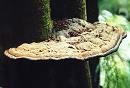
Fungi that grow on wood can be hard with pores that are too small to see, or soft and fleshy with gills.
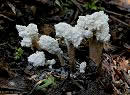
Many insects are attacked, then eventually killed by fungi. When I see these, I always feel pleased that I am at the top of the food chain.