(Schaeff.) X.C. Wang & W.Y. Zhuang 2023
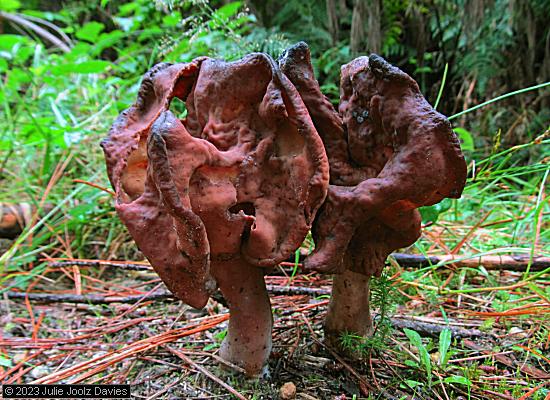
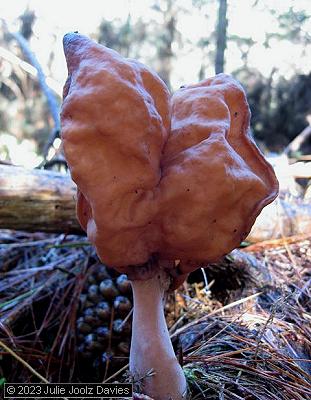
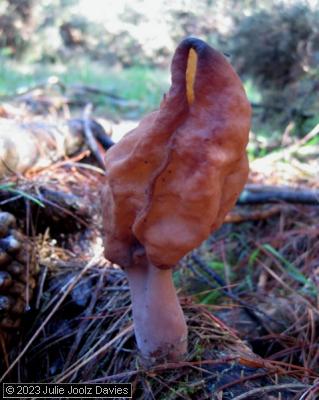
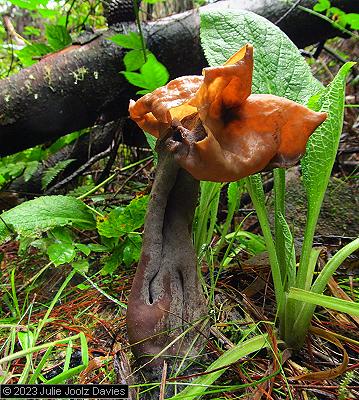
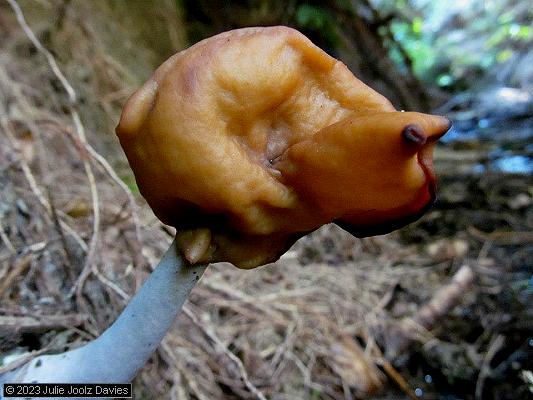
A brown, saddle‑shaped false morel with a distinctive two‑lobed “mitre” cap and a slender hollow stipe, fruiting in late summer to autumn on soil or decaying wood, and the species is gyromitrin‑toxic.
Apothecium: 30-90 mm across; typically two‑lobed or saddle‑shaped, sometimes with three lobes; surface smooth to slightly wrinkled; colour brown to dark chestnut, often darker in the folds.
Hymenium: covers the upper and outer surfaces of the lobes; dull to slightly velvety.
Stipe: 40-120 mm tall, 10-25 mm thick; whitish to pale tan, often slightly flared at the apex; hollow or with a few irregular chambers; surface smooth or faintly grooved.
Context: pale, brittle‑waxy; thin‑walled.
Odour/taste: faint, not distinctive.
Common name: Pouched False Morel
Habitat: Nothofagus and Pine forest
Substrate: Saprobic on soil, humus, or decaying wood
Distribution: New Zealand
Season: Late summer to autumn
Biostatus: Indigenous, non-endemic
Edible: No, toxic
Spore print: White, hyaline