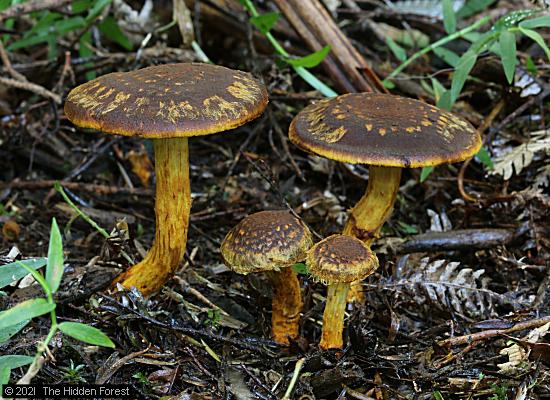
Cortinarius sp.
“Myrtaceae-brown-cluster”
Description:
A small to medium brown, dry species forming tight clusters under Myrtaceae. Caps smooth, warm brown, often with subtle lighter mottling; stipe pale yellow‑cream, moderately stout, with thin fibrillose veil remnants near the apex. Lacks UV fluorescence, separating it from pholiotellus‑type taxa. Likely a distinct undescribed species.

Pileus: 25-50 mm diam., convex to broadly convex, sometimes slightly flattened in older basidiomes. Surface smooth, glabrous, dry.; . Colour warm brown to chestnut‑brown, often with subtle yellow‑brown mottling or lighter patches from the veil, especially toward the margin. Disc slightly darker, margin even, not striate. No evidence of hygrophanous zoning.
Lamellae: Not visible in the photo. Based on stipe and cap morphology, likely adnate to adnexed, medium‑spaced, and brownish at maturity. No violet tones suggested by the stipe or cap.
Stipe: 40-80 x 8-12 mm, stout, cylindrical to slightly clavate, sometimes with a weakly bulbous base. Whitish to pale creamy-yellow, sometimes with yellowish or brownish staining. Surface dry, with fine longitudinal fibrils. Flesh white, firm, unchanging.
Veil: Creamy-yellow , fibrillose, forming scattered patches or faint zones on the upper stipe and cap. No cortina visible.
Context: White, firm, unchanging.
Odour/taste: Not recorded

Common name: None
Habitat: Myrtaceae forest
Substrate: On soil
Distribution: Auckland

Season: Autumn to early winter
Biostatus: Endemic to New Zealand
Edible: No
Spore print: Not recorded but likely rust brown
Macro images:
Inocybe sp.
Scale bar
Scale= 10 mm.
 
The Hidden Forest
Forest Fungi