Clavulinopsis sp.
(sequenced NZ taxon)
Description:
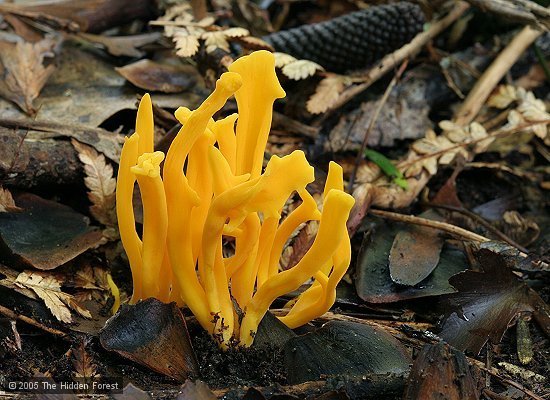
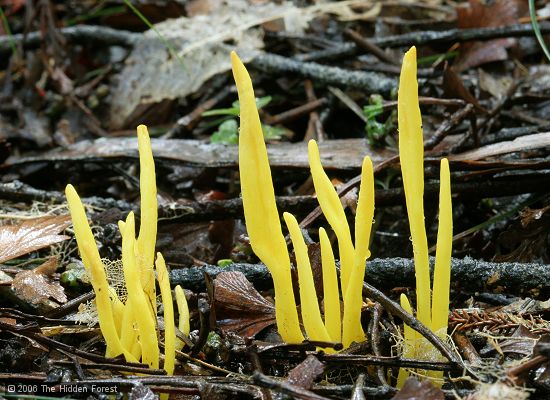
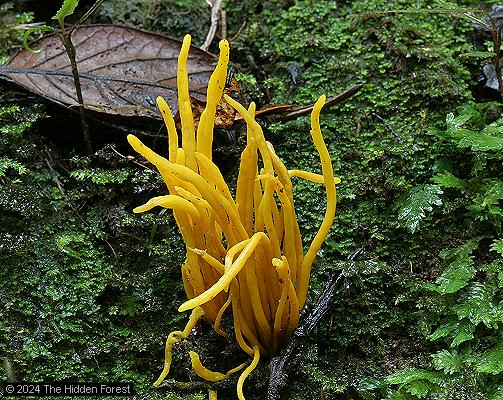
A slender, yellow to orange-yellow club fungus forming scattered to gregarious clusters on soil, moss, or forest litter. Although highly variable in colour and stature, all forms share the same basic morphology: simple, unbranched clubs with smooth surfaces and narrow bases. Sequencing confirms that the bright orange, lemon-yellow, and pale yellow morphotypes all represent one species.

Fruitbodies: Slender, cylindrical, always unbranched.
Form variation: Clubs may be straight, slightly curved, or subtly compressed; some collections appear more tufted or flame‑like, others more evenly spaced.
Apex: Rounded or gently tapered; sometimes paler or slightly translucent.
Colour: Variable: bright orange‑yellow in some collections vivid lemon‑yellow in others occasionally pale yellow. Colour may fade with age or dry weather.
Surface: Smooth, matte to faintly glossy; no grooves or branching.
Base: Narrow, whitish to pale yellow, sometimes slightly rooting into moss or humus.
Flesh: Soft and flexible when fresh; brittle when dry.
Size: 20-60 mm tall, 1-4 mm thick.
Growth habit: Solitary to dense clusters.

Common name: None.
Habitat: Native Forest.
Substrate: On soil.
Distribution: North Island.
Season: Late autumn to winter.
Biostatus: Indigenous.
Edible: No.
Spore print: White.
Macro images:
Ramariopsis simplex
Scale bar
PDD82993    Scale= 7 mm.
 
Ramariopsis simplex
Scale bar
PDD 81207    Scale= 7 mm.
Ramariopsis simplex
Scale bar
PDD 83013   Scale= 7 mm.
Micro images:
Ramariopsis simplex
Scale bar
Magnification = 1000x
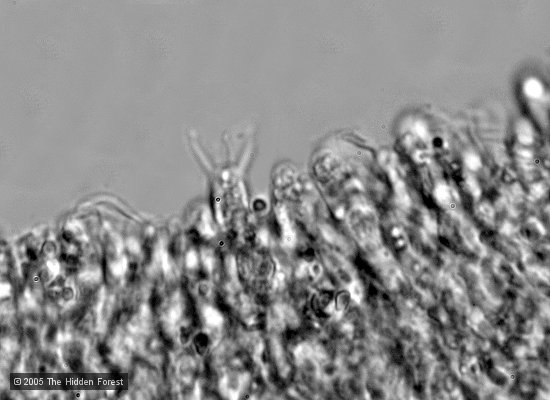
Basida: Photo shows the 4 spored basida
 
 
The Hidden Forest
Forest Fungi