(McNabb) G. Wu, E. Horak & Zhu L. Yang 2021
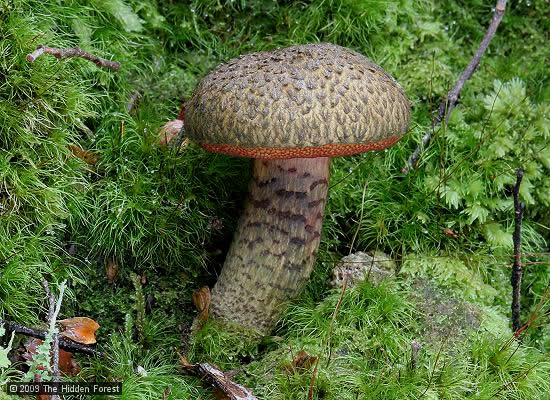
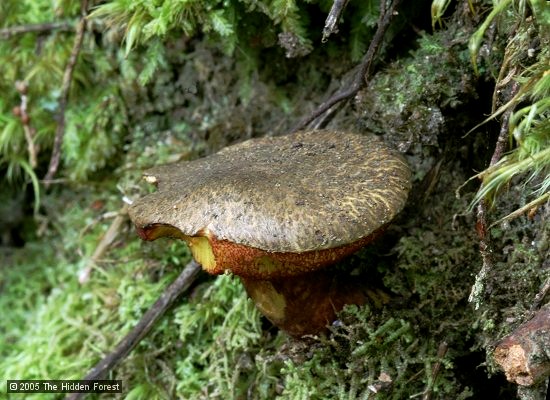
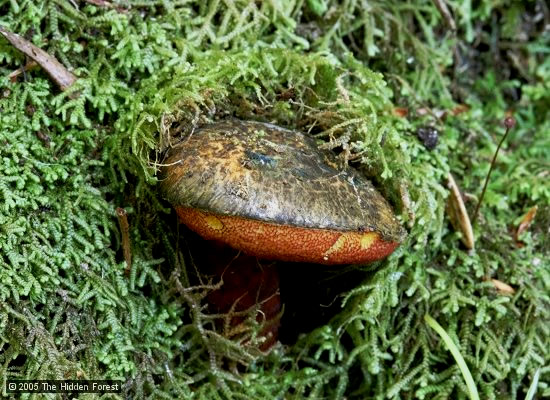
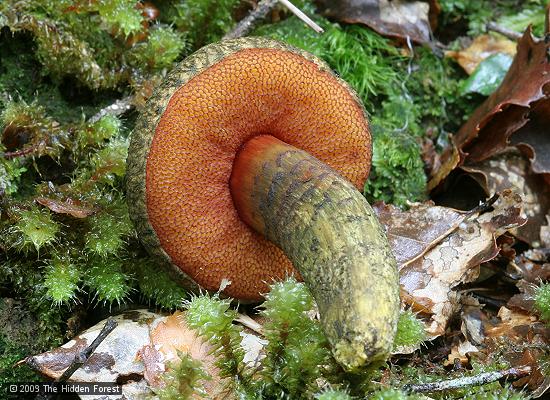
Amoenoboletus mcrobbii is a small, endemic New Zealand bolete distinguished by its olive to yellow‑brown, scaly cap, dark red pores, yellow tubes, and non‑staining flesh, occurring strictly with Nothofagus forests.
Pileus: 20-45 mm diam., convex.
Dry, finely felted to subtomentose when young.
At maturity becoming coarsely fibrillose-scaly as the cuticle ruptures.
Olive at first; rupturing exposes yellowish-brown to reddish context beneath.
Cuticle a disorganised cutis; scales composed of septate hyphae 4-7 µm wide with brownish contents.
Margin entire to slightly crenulate-lacerate, extending beyond the pores.
Hymenophore:
Tubes 6-10 mm long, deeply excavated around the stipe apex.
Tubes yellow.
Pores dark red, angular, 0.5-1 mm wide; pore colour matches the stipe apex.
Stipe: 30-55 mm long.
Apex dark red, concolorous with pores.
Lower stipe paler; ornamentation furfuraceous squamules.
Flesh: Pale; context unchanging when bruised (a key genus character).
Basionym: Xerocomus mcrobbii McNabb 1968.
Common name: None.
Habitat: Under Nothofagus forest.
Substrate: Ground.
Distribution: New Zealand wide.
Season: Autumn.
Biostatus: Endemic NZ.
Edible: Unknown.
Spore print: Brown .