(J.C. Schmidt ex Fr.) Maire 1911
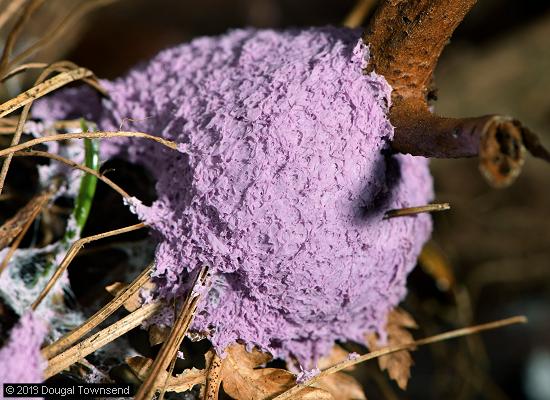
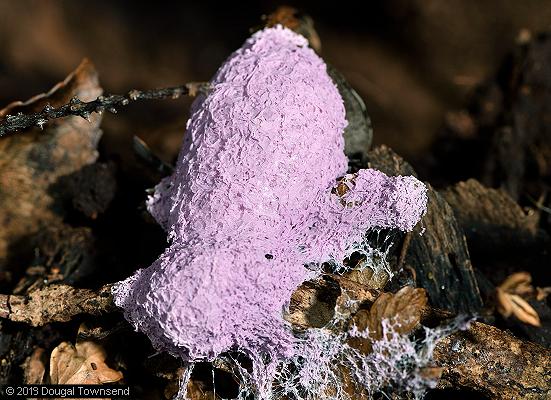
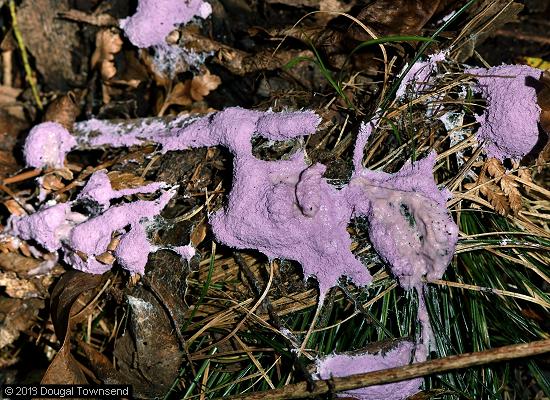
Nectriopsis violacea is a tiny, brightly coloured ascomycete in the Bionectriaceae, recognised by its violet-pink to lilac perithecia that develop directly on the surface of slime moulds, especially Fuligo septica. The perithecia are extremely small, usually less than 0.3 mm, and appear as scattered dots or small clusters on the plasmodiocarps or sporangial crusts of the host. Its distinctive colour and host association make it one of the more recognisable Nectriopsis species when examined with a hand lens.
Perithecia: 0.1-0.3 mm; violet-pink, lilac, or pale purple; smooth; globose; solitary or in small groups.
Colour changes: may fade to pale pink or whitish with age or drying.
Subiculum: sometimes present as a thin, pale, cottony layer beneath the perithecia.
Host specificity: grows directly on slime moulds, especially Fuligo septica; rarely on other substrates.
Common name: none
Found: native bush
Substrate: Fuligo septica
Season: autuam
Height: variable, the same size as the host.
Edible: no
Asci: cylindrical to clavate; 8‑spored; thin‑walled.
Ascospores: hyaline, smooth, 1‑septate; ellipsoid to fusiform; approx. 7-12 x 2-3 µm.
Paraphyse: slender, hyaline, often exceeding the asci.