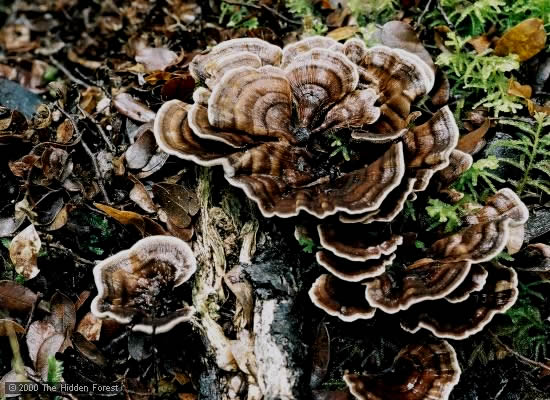
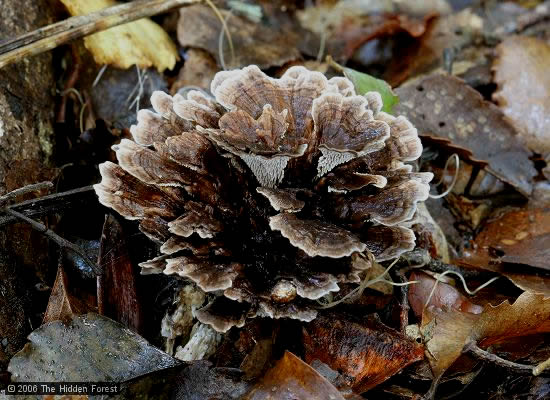
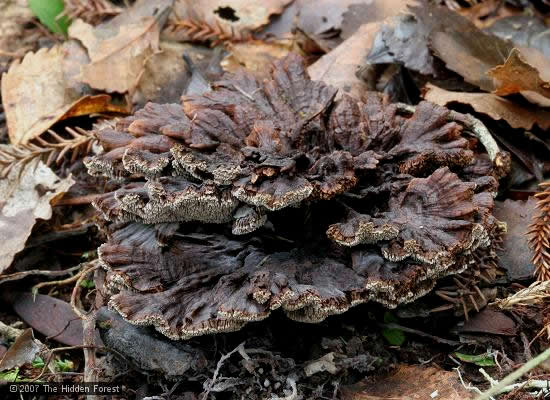
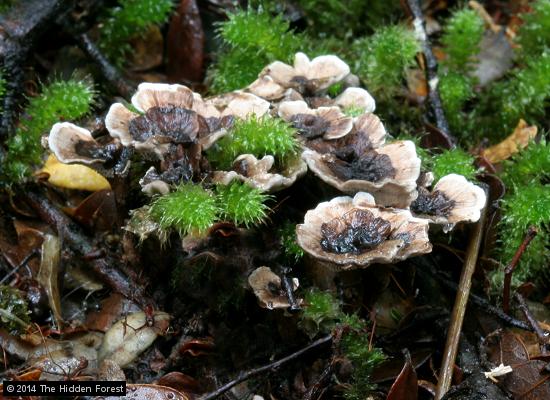
Phellodon nothofagi is a small, tough, soil-dwelling tooth fungus found in southern beech (Nothofagus) forests of New Zealand. It forms dark brown to blackish caps with a distinctly paler, often whitish margin, a key feature that helps separate it from the uniformly dark P. sinclairii. The underside bears a dense layer of short, pale spines, and the flesh is corky and persistent, typical of the genus.
This species is endemic to New Zealand and appears to be uncommon, though likely overlooked due to its small size and sombre colours.
Appears singly or in small, scattered groups; fruitbodies may persist for months.
Cap: 20-50 mm across; circular to irregular; surface dark brown to black, often velvety or finely tomentose; margin distinctly paler, sometimes almost white; faint zonation may be present.
Spines: short (1-2 mm), whitish to pale grey, darkening slightly with age; densely packed.
Stipe: short, thick, often poorly defined; dark brown to black; may be fused with adjacent fruit bodies.
Context: very tough, corky, dark brown to black; does not bruise strongly.
Odour: faint, earthy; not distinctive.
Common name: none
Found: nothofagus forests
Substrate: fruits on soil, often among leaf litter, humus, or moss.
Season: autumn
Height: 45 mm
Width: 80 mm
Edible: no
Spore: brownish, ornamented (typically echinulate); approx. 4-6 µm long.
Basidia: 4-spored.
Hyphae: with clamp connections.