Artomyces colensoi
(Berk.) Jülich
Description:
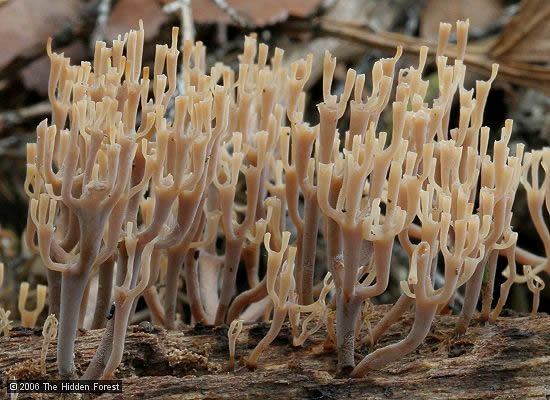
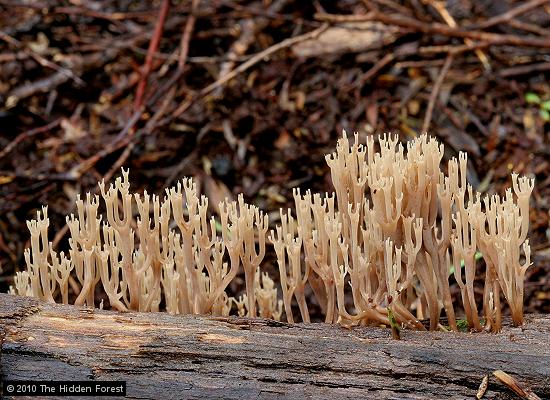
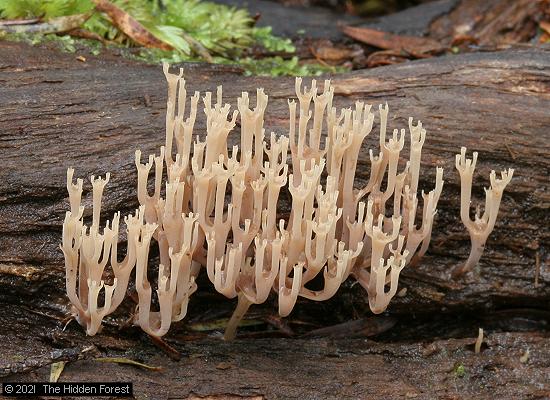
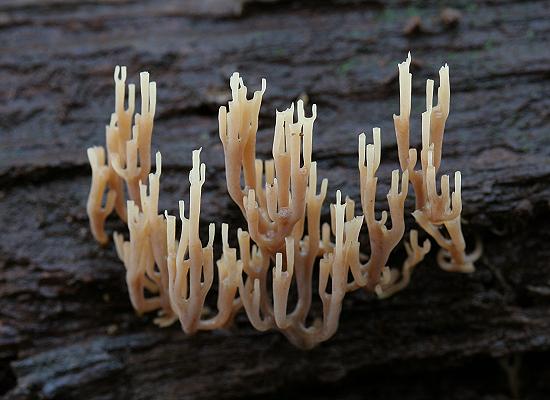
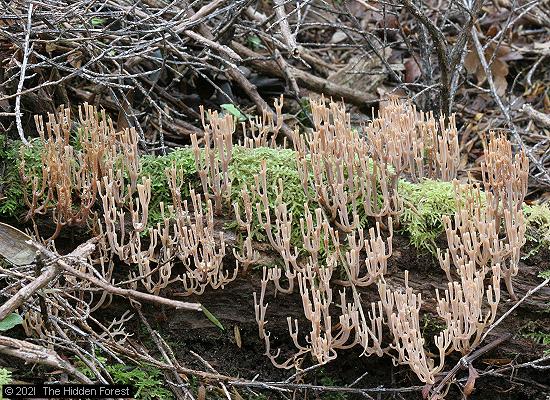
Artomyces colensoi is a delicate, coral‑like fungus native to New Zealand, producing upright, repeatedly branched fruitbodies with the characteristic crown‑tipped branch ends typical of the genus Artomyces. It grows on well‑rotted wood, often on deeply decayed logs where the substrate is no longer recognisable. This species is one of the few truly crown‑tipped corals in the Southern Hemisphere.

Fruitbody: Slender, coral‑like clusters, usually 5–12 cm tall, sometimes forming dense tufts.
Branches: Thin, smooth, and repeatedly forked; branch tips end in a tiny crown of 3–6 points, a key diagnostic feature.
Colour: Pale cream to yellowish when fresh; may become buff or slightly brownish with age.
Texture: Soft and brittle when moist; fragile when dry.
Base: Often narrow and poorly defined, attached to deeply decayed wood.
Common name: None
Found: Native Forest
Substrate: On well‑rotted hardwood or softwood logs.
Season: Autumn
Height: 60mm
Width: 1 mm
Edible: No
Spore: Smooth, hyaline, cylindrical to narrowly ellipsoid.
Basidia: 4-spored, clavate.
Hyphae: Monomitic with clamp connections
Cystidia: Absent
Macro images:
Artomyces colensoi
Scale bar
Scale= 6.2 mm.
 
Artomyces colensoi
Scale bar
Scale= 10 mm.
 
Ramariopsis kunzei
Scale bar
Scale= 10 mm.
 
Ramariopsis kunzei
Scale bar
Scale= 15 mm.
 
Ramariopsis kunzei
Scale bar
Scale= 15 mm.
Micro images:
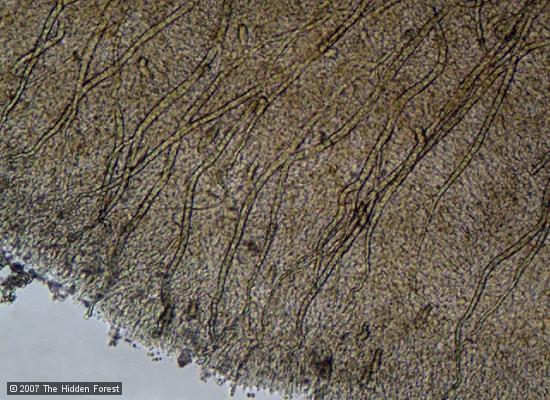
Artomyces colensoi
Magnification = 400x mm.
Gloeoplerous hyphae: scattered in the subhymenium.
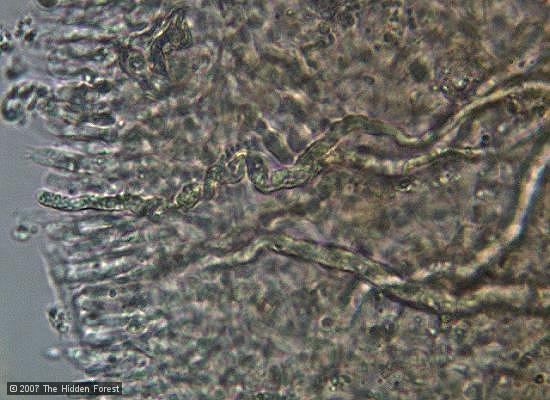
Artomyces colensoi
Magnification = 400x
Gloeoplerous hyphae: showing it ending in gloeocystidia
 
The Hidden Forest
Forest Fungi