Podoserpula pusio var. tristis
(Berk.) D.A. Reid
Description:
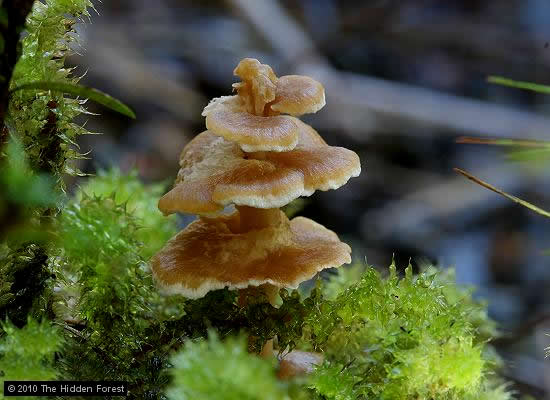
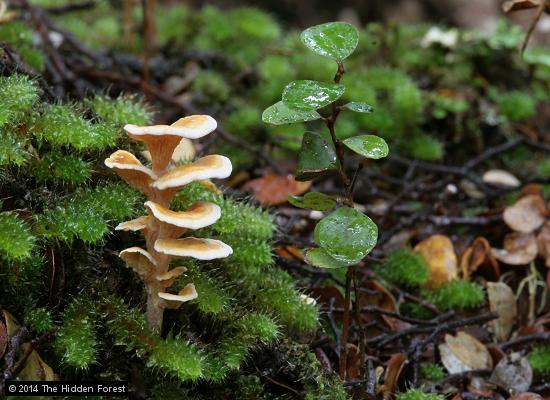
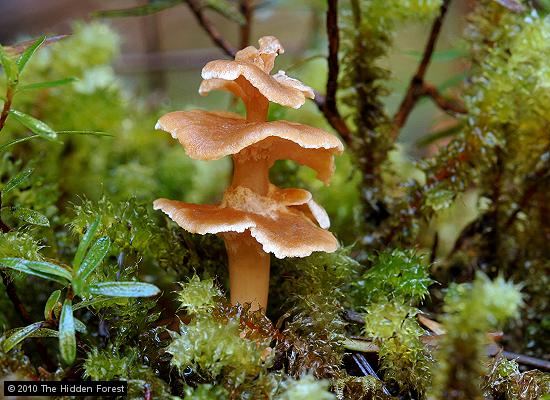
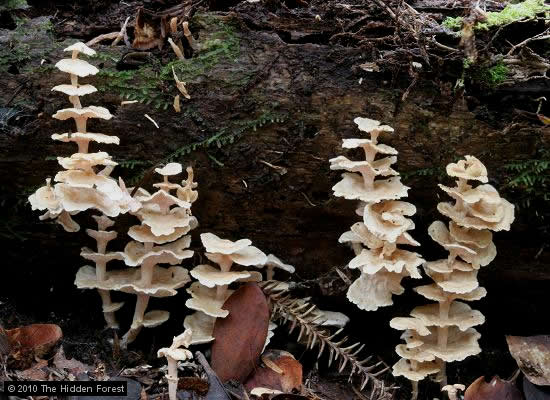
Podoserpula pusio var. tristis is a dark, slender, tiered form of the pagoda fungus, represented by numerous collections in the PDD National Fungal Herbarium. It forms stacked, pagoda‑like tiers, but is typically darker, narrower, and more deeply lobed than the typical P. pusio. The tiers are often more irregular, and the overall fruitbody is more elongated, giving it a “somber” appearance - the origin of the epithet tristis. Often fruits in clusters, sometimes intermixed with typical P. pusio.

Fruitbody: tiered, with 3-10+ stacked lobes; overall height 20-100 mm, but often more slender than P. pusio.
Tiers: deeply lobed, often irregular; margins wavy or crenulate; colours dark buff, brown, or umber, darker than typical P. pusio.
Upper surface: smooth to finely tomentose; often darker toward the centre.
Underside: smooth, sometimes faintly wrinkled; no pores or gills.
Central axis: short, sometimes visible between tiers; tiers radiate outward.
Texture: firm, leathery; persistent.
Common name: Pagoda fungus
Found: common in native forest, urban bush.
Substrate: saprotrophic on soil rich in woody debris, humus, or at the base of rotting logs.
Season: Autumn
Height: 100 mm
Width: 30 mm
Edible: no
Spore: smooth, hyaline, ellipsoid to cylindrical; typically 4-7 µm long (matching P. pusio).
Basidia: clavate, 4‑spored.
Hyphae: monomitic; clamp connections present.
Cystidia: absent.
Macro images:
PodoserpuPodoserpula tristis (D.A. Reid) J.A. Cooper 2023
Scale bar
Scale= 7.8 mm.
 
Podoserpula pusio
Scale bar
Scale= 6.8 mm
 
Podoserpula pusio
Scale bar
Scale= 6.8 mm.
 
The Hidden Forest
Forest Fungi