Leucocoprinus species
Description:
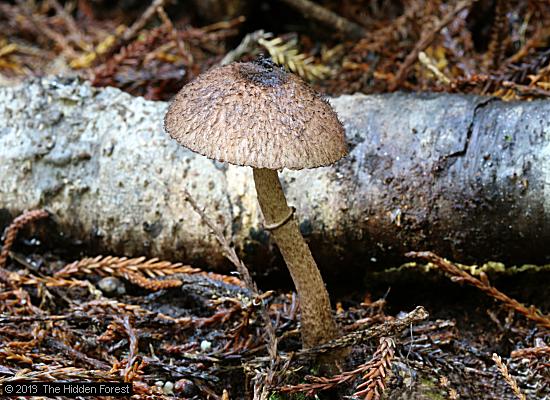
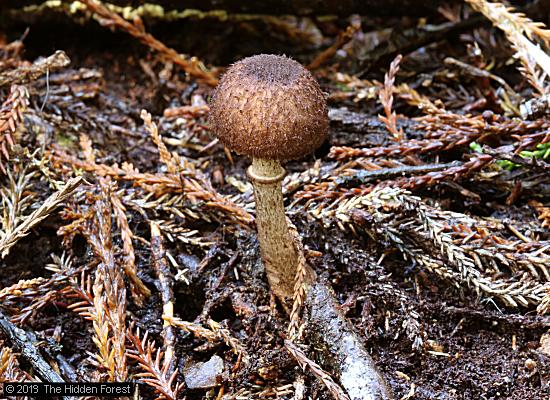
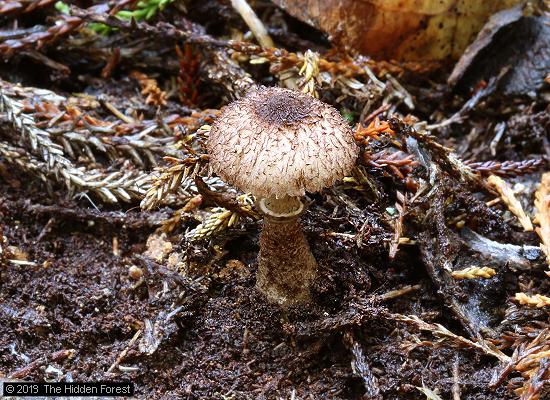
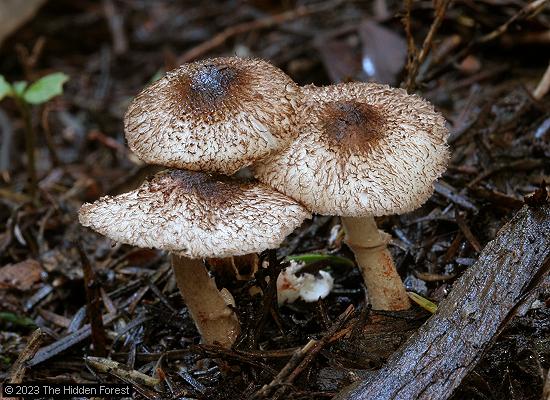
A medium-sized forest parasol with a brown to dark brown cap that is densely fibrous or felted, sometimes appearing shaggy or roughened. The stipe is white, the gills are white and free, and a persistent ring is present. This texture is unusual for Leucoagaricus and makes this group stand out immediately in the field.

Cap:
30-80 mm, convex to plano-convex. Colour brown to dark brown, sometimes with a slightly darker disc. Surface covered in dense, fibrous, hair-like, or felted material – not smooth, not silky, not merely scaly. Fibres may appear radial, tangled, or shaggy, depending on age and moisture. The margin is sometimes slightly inrolled when young. Flesh white, unchanging when cut.
Gills: Free, crowded, broad. White, remaining pale throughout development. Edges smooth.
Stipe: 60-80 x 6-12 mm, slender, white. The surface is smooth or faintly fibrillous. Ring thin but persistent, usually superior. The base is not strongly bulbous.

Common name: None.
Habitat: Lowland podocarp forest.
Substrate: Deep leaf litter.
Distribution: Auckland.
Season: Late summer to early winter.
Biostatus: Endemic, undescribed species.
Edible: Unknown.
Spore print: White.
Macro images:
Leucocoprinus sp.
Scale bar
Scale= 8 mm.
 
Leucocoprinus sp.
Scale bar
Scale= 8 mm.
 
Leucocoprinus sp.
Scale bar
Scale= 6.5 mm.
 
Leucocoprinus sp.
Scale bar
Scale= 8 mm.
 
Hidden Forest
Forest Fungi