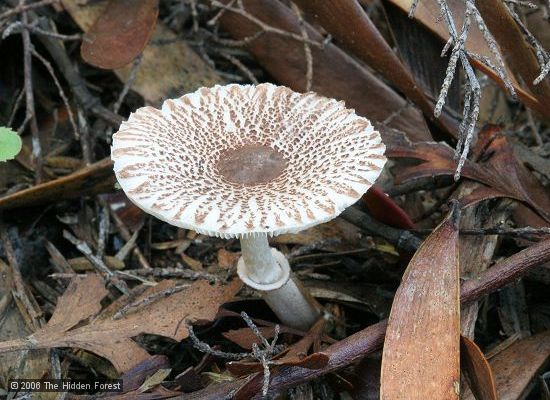
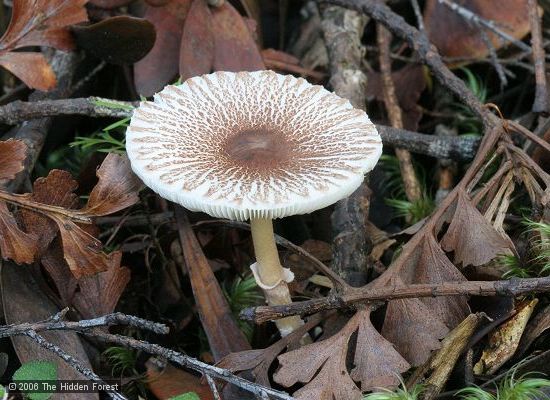
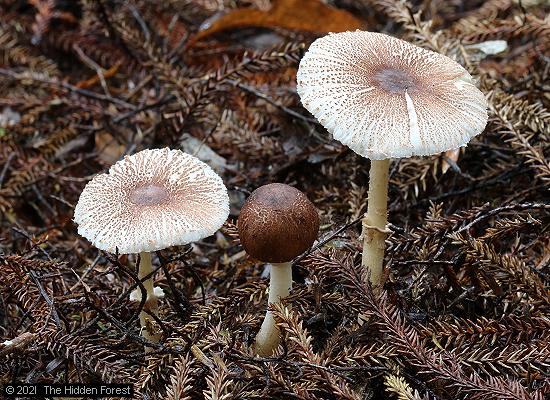
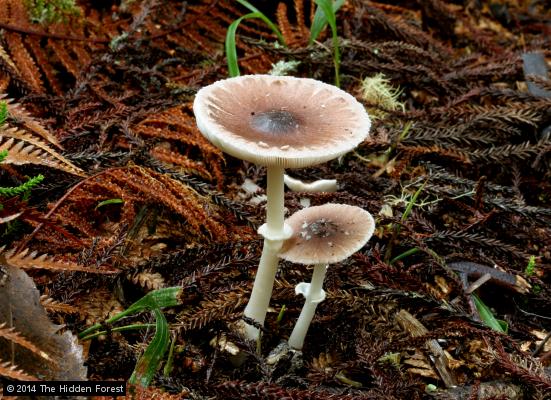
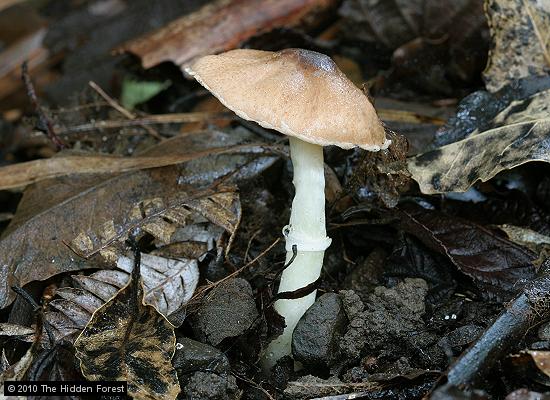
Medium‑sized forest parasols with a brown to dark brown cap when young, becoming pale with brown radial patches as the thin pigmented surface splits during expansion. Always with white gills, white stipe, and a persistent ring.
Cap: 40-60 mm, convex to plano‑convex. Immature: cap uniformly brown, sometimes quite dark. Mature: the thin brown cuticle ruptures, producing pale cream backgrounds with brown radial streaks or patches and a darker brown disc. The surface may appear scaly, but the “scales” are actually split fragments of the pigmented skin, not true raised scales. Flesh white, unchanging when cut. This developmental colour change is the defining feature.
Gills: free, crowded, broad. White, remaining pale throughout. Edges smooth.
Stipe: 60-100 x 8-15 mm, slender to moderately stout. White, smooth or faintly fibrillose. Ring thin but persistent, usually superior. The base is sometimes slightly swollen but not strongly bulbous.
Common name: Brown Leucoagaricus.
Habitat: Lowland podocarp forest, early season.
Substrate: Grows in deep leaf litter.
Distribution: Auckland.
Season: Autumn.
Biostatus: Endemic, undescribed species.
Edible: Unknown, to small.
Spore print: White.