Leucoagaricus species
Description:
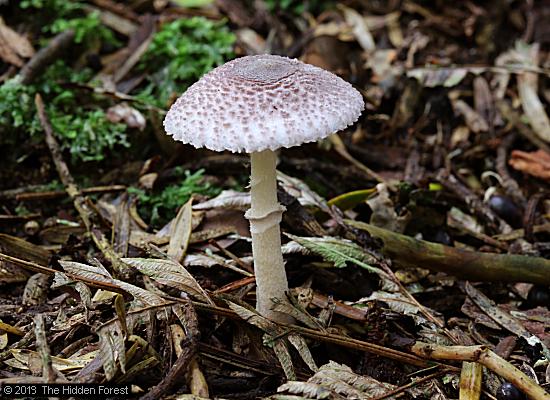
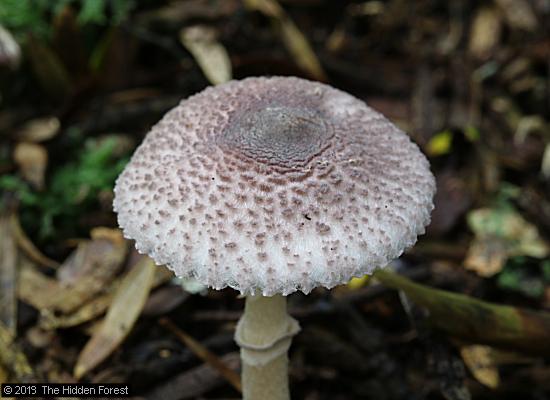
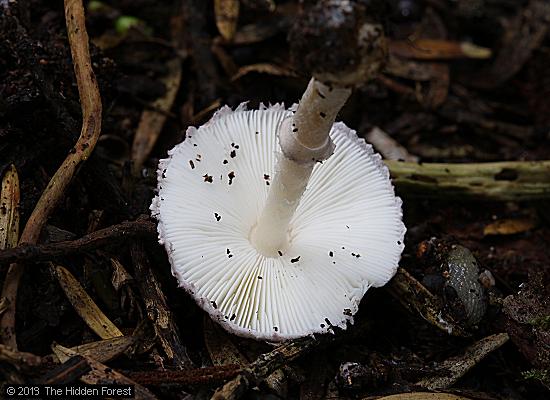
A medium-sized forest parasol with a dark purplish-brown cap when young. As the cap expands, the thick pigmented cuticle ruptures, forming radial rows of raised tufts or plates. Gills are white and free; the stipe is white, and a persistent ring is present.

Cap: 30-80 mm, convex to plano-convex. Immature: uniformly dark brown to purple-brown, smooth or slightly velvety Mature: the thick cuticle splits into radial, raised tufts; pale flesh shows between the tufts; the centre remains dark purplish-brown. The margin is sometimes slightly inrolled when young. Flesh white, unchanging when cut.

This is not true scaling – it is rupture of a thick pigmented skin, similar in mechanism to the brown pigmented‑cuticle form, but much darker and more tufted.

Gills: free, crowded, broad. White, remaining pale throughout development. Edges smooth.
Stipe: 60-120 x 6-12 mm, slender, white. Surface smooth or faintly fibrillous. Ring thin but persistent, usually superior. The base is not strongly bulbous.

Common name: Purple Leucoagaricus.
Habitat: Lowland podocarp forest.
Substrate: Deep leaf litter.
Distribution: Auckland.
Season: Autumn.
Biostatus: Endemic, undescribed species.
Edible: No, to small.
Spore print: White.
Macro images:
Leucocoprinus species
Scale bar
Scale= 10 mm.
 
Leucocoprinus sp.
Scale bar
Scale= 5 mm.
 
Leucocoprinus species
Scale bar
Scale= 11 mm.
 
Hidden Forest
Forest Fungi