Agaricus species
Description:
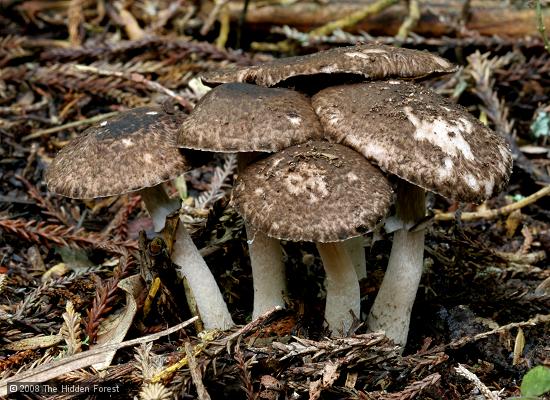
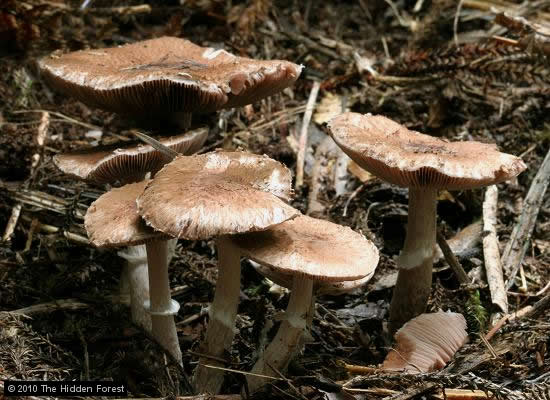
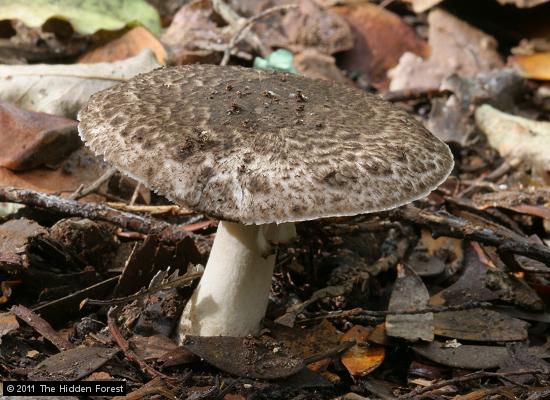
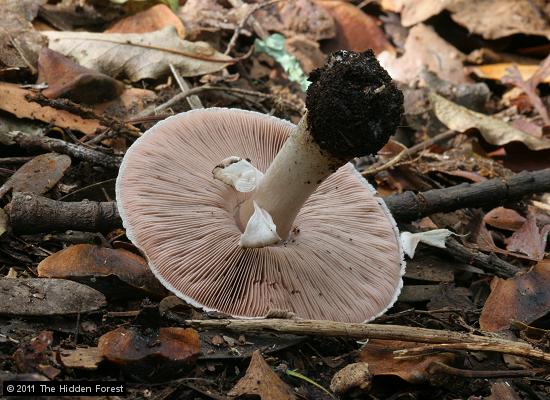
A medium-sized, brown-capped Agaricus frequent in lowland podocarp–broadleaf forest. Recognised by its dry, brown, fibrillose–scaly cap, white stipe with a simple ring, chocolate-brown gills, and absence of strong yellowing or phenolic odour.

Cap: 40-100 mm diam.; convex to plano-convex; surface dry, brown, with innate fibrils and small appressed scales, especially toward the centre; margin paler, sometimes slightly uplifted in age.
Gills: free, crowded; pale pinkish-brown when young, becoming dark chocolate-brown at maturity; edges even.
Stipe: 50-100 x 8-20 mm; white, smooth to finely fibrillose; sometimes slightly thickened at the base; no bulb.
Ring: simple, thin, membranous, persistent in some specimens but often collapsing with age; no cog-wheel pattern.
Context: white, firm; no rapid yellowing; may show faint, slow yellowing at the extreme base.
Odour: mild, mushroomy; no phenolic/inky smell, no almond/anise detected in most collections.

Common name: Bush agaric.
Habitat: Podocarp-broadleaf forest.
Substrate: Ground.
Distribution: New Zealand wide.
Season: Autumn.
Biostatus: Endemic.
Edible: Unknown.
Spore print: Dark brown.
Macro images:
Agaricus sp.
Scale bar
Scale= 10 mm.
 
Agaricus sp.
Scale bar
PDD 125700    Scale= mm.
 
Agaricus sp.
Scale bar
Scale= 10 mm.
 
Agaricus sp.
Scale bar
PDD 10222    9Scale= 5.5 mm.
 
Agaricus sp.
Scale bar
Scale= 7 mm.
 
Agaricus sp.
Scale bar
PDD 102229    Scale= 7 mm.
 
Hidden Forest
Forest Fungi