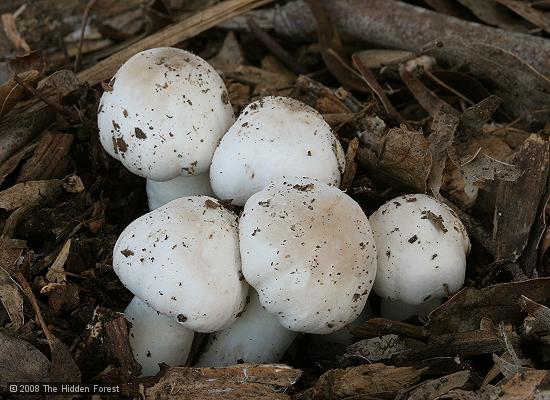
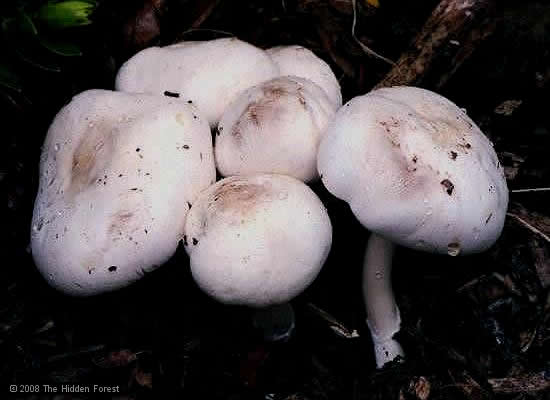
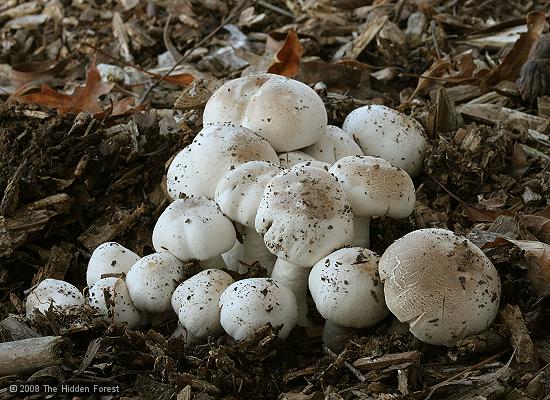
A small to medium-sized Agaricus that fruits in dense clusters on woodchip mulch, especially in urban parks and garden beds. Recognised by its smooth white to pale tan cap, clustered habit, simple ring, and lack of yellow staining. This species is not the same as lawn Agaricus and not the same as the native forest taxa - it is a woodchip specialist, likely introduced.
Cap: 30-70 mm diam.; convex to broadly convex; surface smooth, white to pale tan; often with fine soil specks; margin even, sometimes slightly splitting in age.
Gills: free; white in very young buttons, quickly turning pink, then dark chocolate-brown at maturity.
Stipe: 40-80 x 6-15 mm; white, smooth; base not bulbous; often slightly curved due to clustered growth.
Ring: simple, thin, fragile, often collapsing or disappearing in older specimens.
Context: white; yellow staining at base of stipe when cut or bruised.
Odour: mild, mushroomy; no phenolic smell.
Common name: Urban Woodchip Agaricus.
Habitat: Common in urban parks, playgrounds, street plantings, and mulched garden beds.
Substrate: Saprobic on woodchip mulch, bark chips, and decomposing landscaping material.
Distribution: Common New Zealand wide .
Season: Autumn.
Biostatus: Introduced.
Edible: Poisonous, cause gastrointestinal upsets.
Spore print: Dark brown .