(Berk.) Rajchenb. (1995)
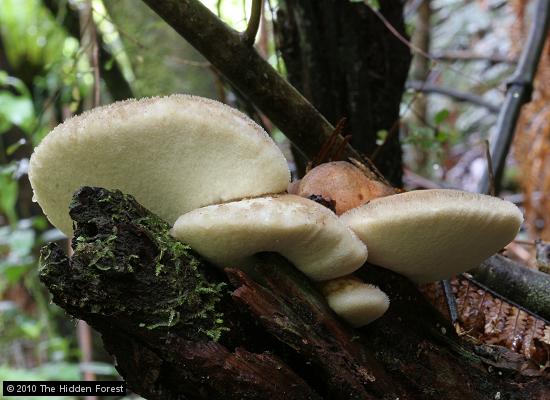
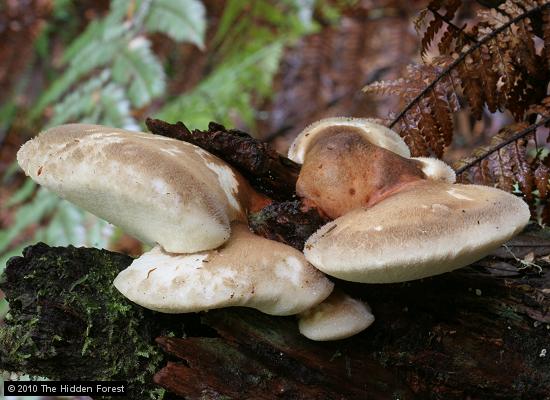
A large, spongy, brown-rot polypore of the Laetiporaceae, widespread in Australasia notable for its ungulate to bell-shaped basidiomes, soft crumbling context, and globose spores. This species is one of the most distinctive Laetiporus taxa in the Southern Hemisphere. More often than not, these are found on the forest floor after falling from a tree branch above. They decay very slowly, gaining a texture like a wet sponge.
General form: Annual, solitary, spongy, attached by an apical or lateral stem-like base.
Basidiomes often detach soon after maturity, leaving hoof-like remnants on the substrate.
Pileus: Ungulate or bell‑shaped, very large: 70-350 mm wide 50-150 mm thick. Surface: Glabrous or finely tomentose-reticulate. Colour greyish white to ochraceous to tobacco brown. Covered with a delicate membrane that becomes brittle when dry and peels away easily. Margin: Entire or lobed.
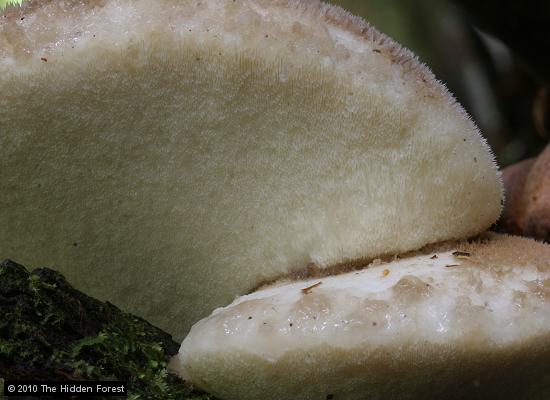
Hymenophore: Pore surface: Plane or slightly convex, becoming creviced with age. Straw or honey-coloured. Pores: Large, 1-3 per mm. Round to angular.
Context: White, soft, crumbling
Odour/taste: unknown
Common name: NoneSmoky Bracket
Habitat: Nothofagus forest
Substrate: Saprobic, on decaying wood
Distribution: New Zealand wide
Season: Autumn to early winter
Biostatus: Indigenous
Edible: No
Spore print: White